
Understanding Market Movements: Economic Indicators Explained in Plain English
Decoding the Pulse of the Global Economy
Have you ever wondered why the stock market takes a sudden nosedive or why your morning coffee suddenly feels a bit more expensive? Market movements often feel like a chaotic rollercoaster, but they are actually driven by predictable economic indicators that act as the economy’s vital signs. Think of these indicators as a diagnostic dashboard for the financial world, providing investors with the data needed to make informed decisions. When we talk about economic health, we are essentially looking at a few key data points that tell us if the engine is running smooth or overheating. By learning to interpret these signals, you can move from feeling like a spectator to becoming an active participant in your financial future. This guide is designed to strip away the complex jargon and give you the plain-English insights you need to understand how the market really ticks. Whether you are a seasoned trader or a curious beginner, mastering these basics will empower you to see the logic behind the fluctuations. Let’s dive into how these signals shape the world around us. Are you ready to decode the mystery of market volatility together?
The Big Three: GDP, Inflation, and Employment
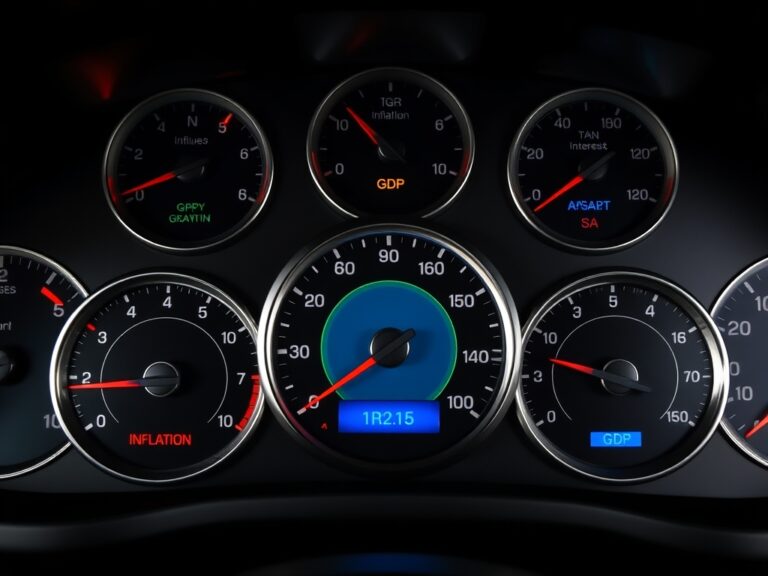
At the very foundation of market analysis sit three giants: Gross Domestic Product (GDP), Inflation, and Employment rates. GDP serves as the scorecard for a nation’s total economic output, essentially telling us if we are producing more goods and services than the previous quarter. When GDP growth is robust, it usually signals a healthy, expanding market, which is generally good news for investors. On the other hand, inflation measures the rate at which prices rise, acting as the silent tax on your purchasing power. If inflation climbs too fast, central banks often step in by raising interest rates to cool things down, which ripples through everything from your mortgage to stock prices. Meanwhile, the unemployment rate provides a human-centric view of economic health; when people are working, they spend money, driving corporate profits higher. These three indicators are the primary pillars that dictate market sentiment. Understanding them is not about predicting the future with 100% accuracy, but rather about positioning yourself to handle whatever the market throws your way. By keeping an eye on these metrics, you can understand the ‘why’ behind major market shifts.
Why Interest Rates are the Market’s Puppet Master
If you want to know what makes institutional investors sweat, look no further than interest rates set by the Federal Reserve or other central banks. Think of interest rates as the ‘cost of money’; when they are low, borrowing is cheap, which encourages businesses to expand and consumers to spend. This environment usually fuels bull markets, as companies can easily finance growth and innovation to boost their bottom lines. Conversely, when rates rise, the cost of debt increases, which forces companies to tighten their belts and can lead to a slowdown in economic activity.
- Higher rates make borrowing expensive.
- Lower rates encourage consumer spending.
- Central banks use rates to tame inflation.
This back-and-forth dance is what we call monetary policy, and it is perhaps the most influential factor in short-term market movements. Savvy investors watch central bank meeting minutes as if they were a blockbuster movie script, looking for hints about the future direction of these rates. When you hear that rates are ‘hawkish’ or ‘dovish’, you now know that means someone is either preparing to squeeze the economy or let it run free. Keep this balance in mind whenever you evaluate your portfolio.
Navigating the Noise: Sentiment and Forward-Looking Data
Beyond the hard numbers, the market is also heavily influenced by investor sentiment and forward-looking data points like the Purchasing Managers’ Index (PMI). While GDP tells you where the economy has been, the PMI tells you where it is heading by surveying business leaders about their future orders. If the index is above 50, business activity is expanding, and if it is below 50, we might be looking at a contraction. It is important to remember that markets are essentially a collection of human expectations, meaning they often ‘price in’ news before it actually happens. This is why you might see a stock price drop even on ‘good’ news—the market already anticipated that outcome and is now looking for the next catalyst. Emotional volatility is real, but smart investors focus on the long-term trends rather than the daily headlines. Use these indicators to build your own thesis instead of reacting to the fear or greed of the crowd. With patience and a steady hand, you can navigate even the choppiest waters. Remember: the goal is to make informed decisions that align with your personal financial objectives, not to win every single day.